EmptyLegFinder.aero
315 clicks.
227 marketplace entries.£1.69 per primary conversion.
April 1 to April 7, 2026. One locked proof week from one of my own businesses, showing what happens when message, intent, and conversion path line up in a market full of bigger brands.
Honest proof is more useful than bigger claims.
Before this becomes a case study, it needs one important clarification.
EmptyLegFinder is not being shown as proof that I can close private jet sales. It is being shown as proof of the part I actually control: selecting the right traffic, matching it with the right message, moving it through the right conversion path, and doing it with numbers clear enough to withstand scrutiny.
For EmptyLegFinder, the primary conversion action is entering the marketplace. For a law firm, accountant, consultant, or trades business, that same hand-raise might be a booked call, quote request, or enquiry. The vertical is different. The logic is the same.
The business, the market, and the way I set the system up.
THE BUSINESS
A live proving ground, not a hypothetical one.
EmptyLegFinder.aero is a live private aviation marketplace connecting passengers with discounted empty leg flights: unsold private jet inventory offered at significantly lower rates than standard charter.
I own and operate it myself. That makes it a useful proving ground for the methodology behind The Lead Engine.
There is no client buffer here. Every pound of ad spend is real money. Every optimisation decision has a direct consequence. If the campaign wastes budget, it wastes my budget. If the landing page underperforms, the cost is immediate.
THE CHALLENGE
A serious market with larger brands and deeper budgets.
Private aviation is not a forgiving search market. The larger players have more brand awareness, larger teams, deeper budgets, and far more room for waste than most owner-led businesses will ever have.
Competing head-to-head on brute force would have made no sense. So the campaign was not built to win by spending more. It was built to win by being more relevant.
That meant choosing intent-heavy search terms instead of broad prestige terms, writing ads that matched what the searcher actually wanted, and sending paid traffic into a focused conversion path rather than a general browsing experience.
THE APPROACH
Reduce the distance between search intent and the primary action.
On the traffic side, the focus was on tightly targeted paid search terms with clear commercial intent. On the page side, the job was not to entertain or educate endlessly. It was to get the right visitor to take the next meaningful step.
For EmptyLegFinder, that step is Enter The Marketplace.
Some paid users arrive via the landing page and then progress into the marketplace. Others enter directly through a deliberate ad route. Both are valid parts of the campaign. What matters is that the path is intentional, measurable, and commercially useful.
PROOF WINDOW
April 1 to April 7, 2026
The numbers on this page come from a single representative week. They are not blended across months and they are not selective lifetime averages.
Google Ads
On-Site Behaviour
Conversion Path Breakdown
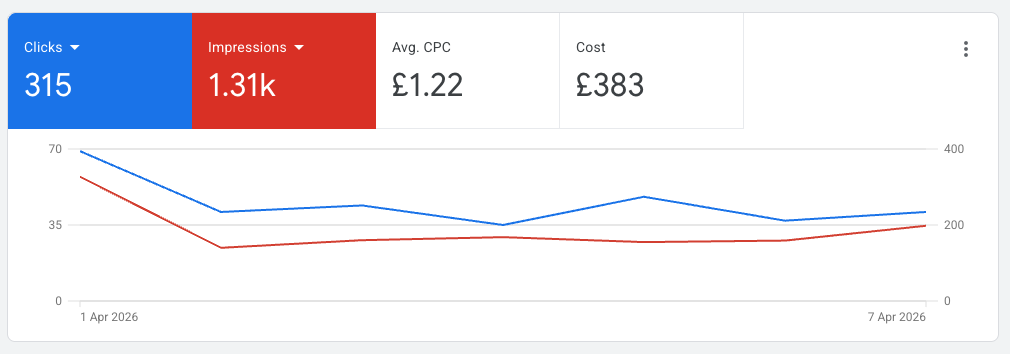
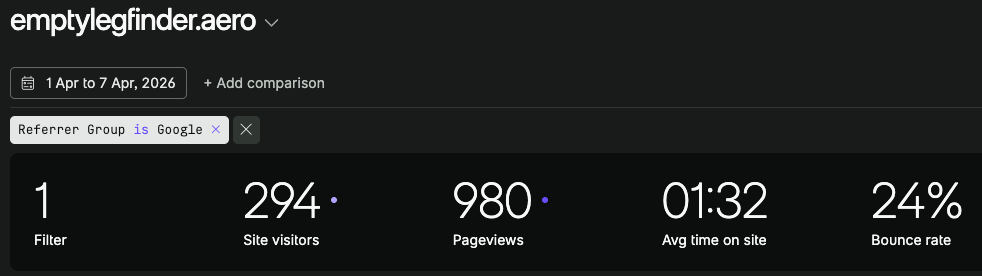

The most important figure on the page is not the click count. It is the primary conversion count.
During the week, paid Google traffic produced 227 marketplace entries at a cost of £1.69 per primary conversion. Of the 278 visitors who reached the landing page, 209 progressed into the marketplace. That gives the landing page a 75.2% progression rate for the defined primary action.
An additional 18 users entered the marketplace directly from a paid ad route. Those are still valid primary conversions. They are simply not landing-page progressions, and should not be presented as such.
Strong numbers at the campaign level. Strong intent match underneath.
The campaign-level CTR for the week was 24.10%, which is the best top-line proof because it reflects the performance of the system as a whole. Underneath that, individual non-brand keywords also showed strong intent match.
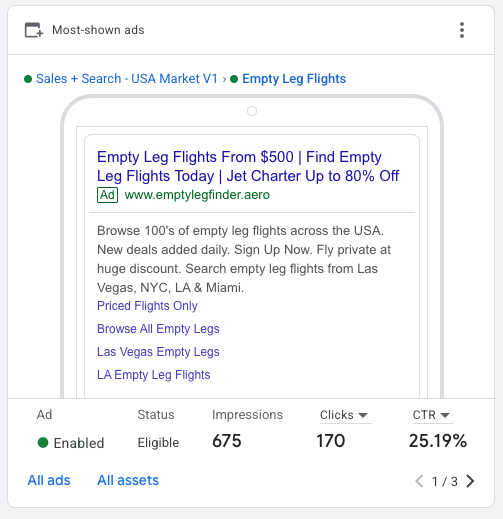
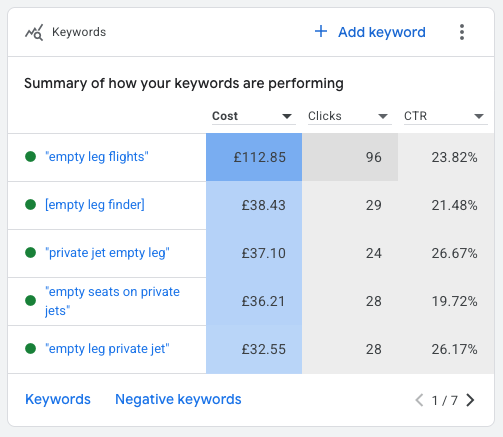
These are not included to show off a single outlier. They support a broader point: when the query, the ad, and the conversion path are tightly aligned, the numbers stop looking average.
Competing in serious auctions without pretending to dominate the market.
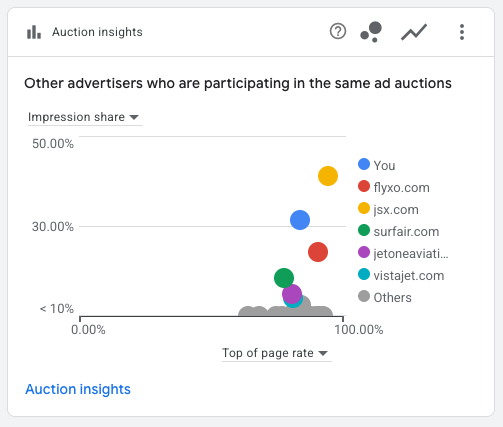
Auction Insights for the same week show EmptyLegFinder appearing in the same paid search auctions as much larger aviation brands.
During the same April 1 to April 7 window, EmptyLegFinder held a 31.28% impression share. That is not a claim of market dominance. It is a more useful signal than that. It shows the campaign was competing in a serious auction environment and still generating commercially meaningful results on a relatively modest budget.
The vertical is different. The logic is the same.
This is not a media-buying story in the usual sense. It is a relevance story.
The campaign does not work because the budget is huge. It works because the traffic is chosen carefully, the message is matched properly, and the path from click to primary action is kept clean.
That is the part many service businesses never get from agencies. They get traffic without intent, or a landing page without message match, or reporting without accountability. Then each piece blames the other when the numbers stall.
If you run a service business, your version of Enter The Marketplace will likely be different. It might be a booked consultation, a quote request, or an enquiry submitted.
Choose keywords for intent, not vanity.
Match the ad to what the searcher actually wants.
Send them into a focused conversion path.
Track the agreed hand-raise properly.
Keep optimising until the cost of that action starts to make commercial sense.
That is the same thinking behind The Lead Engine.
If you want to see what that same level of intent, clarity, and accountability could look like in your business, the next step is a conversation.
I did not build this methodology on a client's money first. I built it inside one of my own businesses, where the feedback loop is immediate and the consequences are real.
That does not mean every service business will produce aviation numbers. It means the system has already been tested under pressure, with real spend, real competition, and no room for vague reporting.